

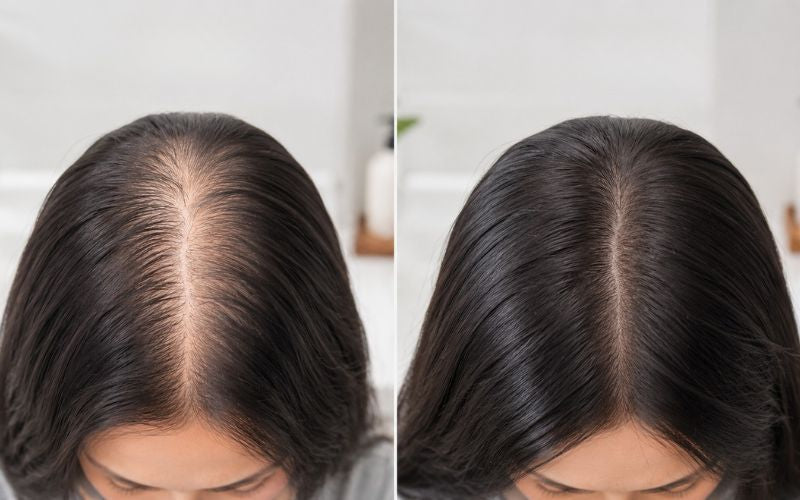
Most people use fine and thin as if they're the same word. They're not, and the difference matters more than you'd think. Getting this wrong means buying the wrong products, following the wrong advice, and wondering why your hair still doesn't look or feel the way you want it to.
What Does Fine Hair Actually Mean?
Fine hair refers to the diameter of each individual strand. A single fine hair strand is physically narrow, smaller in circumference than a normal or coarse strand. Roll one between your fingers and you can barely feel it. That near-invisibility is the hallmark of fine hair.
Fine hair says nothing about how much hair you have. Someone with fine hair could have a full head of densely packed strands. High-density hair that is fine in texture can still look voluminous, but those individual strands are fragile, prone to breakage, and quick to fall flat without the right products.
Fine hair versus coarse hair comes down purely to strand width. Coarse hair has a wider diameter, which is why it tends to feel rougher and hold its shape more easily.
What Does Thin Hair Actually Mean?
Thin hair refers to density, meaning how many strands exist across the scalp. Thin hair means fewer hairs per square inch, not necessarily that each strand is narrow. Someone with thin hair might have perfectly normal strand thickness but simply fewer strands overall, which leaves more scalp visible and makes hair appear less full.
A simple way to gauge it: pull your hair into a ponytail. If the circumference is over four inches, density is on the higher side. Less hair in that tie points to low density.
Hair density is largely genetic, but it can also be affected by hormonal changes, stress, and conditions like androgenetic alopecia. If you're noticing more strands on your pillow or in the shower drain than usual, that could be a sign of thinning rather than simply having naturally thin hair. Our article on the signs and symptoms of hair loss covers what to watch for in more detail.
Can You Have Fine and Thin Hair at the Same Time?
Yes, and this is where it gets tricky. Fine and thin hair together means both low strand thickness and low density. This combination gives the least volume to work with and makes the scalp particularly visible. It also tends to be the hair type most affected by product buildup and heavy formulations, which weigh down the little hair that's there.
On the other end, fine hair with high density can look quite full when cared for correctly, even though each strand is delicate. Understanding which combination you're dealing with changes everything about how you approach your routine.
How to Care for Fine or Thin Hair
Styling Fine Hair
The goal with fine hair is to build volume and body without weighing individual strands down. Avoid heavy creams, oils, and silicone-laden products that coat the strand and cause it to collapse. This is exactly why REGROW formulas are free from silicones, sulfates, and parabens. Lightweight mousses and volumising sprays work far better. Blow dry with a round brush from the roots for lift, and style while hair still has a little moisture in it for the best hold.
Styling Thin Hair
Styling thin hair is about creating the appearance of more density. Applying product at the roots adds texture and separates strands so less scalp shows through. A side parting rather than a centre parting distributes hair more evenly across the scalp. Avoid pulling thin hair into tight styles that flatten it against the head and make the scalp more visible.
Choosing the Right Shampoo
For both hair types, the shampoo you use matters enormously. Sulfate-based cleansers strip the scalp of its natural oils and can worsen both fragility and thinning over time. REGROW's Women's Shampoo and Men's Shampoo are formulated without sulfates, parabens, silicones, or artificial colours.
Active ingredients like caffeine, niacinamide, saw palmetto, and biotin work to support the scalp and hair at the follicle level, not just at the surface. Our guide on types of shampoo and what they do is worth reading if you want a deeper breakdown.
It's also worth understanding why these ingredients matter. Our blog on why silicones, sulfates, and parabens are harmful to hair goes into the full picture.
Supporting Hair Growth
If you're dealing with thin or thinning hair, scalp health is as important as what you do to the strands themselves. A healthy scalp environment supports better growth at the follicle level. This means choosing active ingredients that reduce inflammation, improve circulation, and keep the follicle environment clean and unobstructed.
REGROW's full hair growth system, including shampoo, conditioner, and tonic, is built specifically for this. The Women's Tonic and Men's Tonic are designed to be used alongside the cleansing and conditioning steps, working at the scalp level to support thicker, healthier-looking hair over time.
Fine Hair vs Thin Hair: A Quick Summary
Fine hair is about strand thickness. Thin hair is about density. You can have one without the other, or both at the same time. Knowing the difference means you can stop guessing and start treating the actual issue.
At REGROW UK, every product in our range is formulated specifically for real hair concerns, whether that's adding volume to fine strands, supporting a thinning scalp, or both. Free from the ingredients that cause damage and built around activities that actually work. Because every strand you have deserves the best.
Frequently Asked Questions
Is it possible to have fine hair but not thin hair?
Yes. Fine hair describes the width of each strand, while thin hair describes how many strands you have overall. Someone can have narrow, fine strands packed densely across the scalp, which still gives the appearance of fullness even though each individual hair is delicate.
How can I tell if my hair is fine, thin, or both?
A simple starting point is the ponytail test: gather your hair into a tie and measure the circumference. A thicker ponytail usually points to higher density, while a thinner one suggests lower density. Separately, rolling a single strand between your fingers gives you a sense of its width. If you can barely feel it, that strand is fine.
Does fine or thin hair mean I'm losing hair?
Not necessarily. Having naturally fine or thin hair is simply a hair type, not a sign of hair loss. That said, if you're noticing more shedding than usual, such as extra strands on your pillow or in the shower drain, that's worth paying attention to separately from your natural hair type.
Should fine hair and thin hair be treated the same way?
Not exactly. Fine hair benefits from lightweight products that add volume without weighing strands down, while thin hair benefits from techniques that create the appearance of density, such as root-lift styling or a side parting. There's overlap in good practice for both, but the goals are slightly different.
Can product buildup make fine or thin hair look worse?
Yes. Heavy creams, oils, and silicone-based products tend to coat the strand and weigh it down, which is especially noticeable on fine or low-density hair. Lighter, buildup-free formulas tend to work better for both hair types.
Will switching products actually make a visible difference?
It can, particularly when the switch addresses what's actually causing the issue. Choosing lightweight, sulfate-free formulas suited to fine or thin hair, along with scalp-supportive ingredients, is a meaningful step, though results build gradually with consistent use rather than overnight.